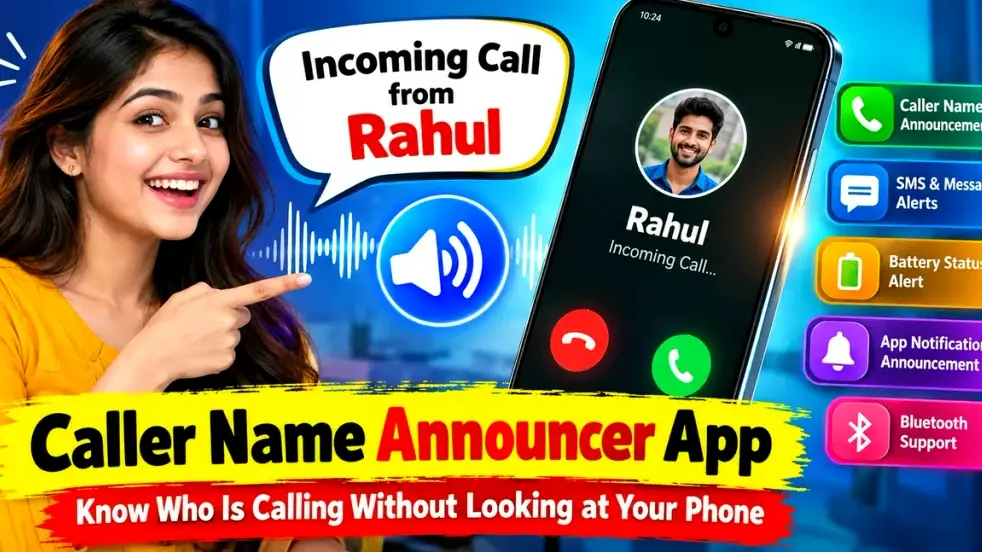
Caller Name Announcer App – Know Who Is Calling Without Looking at Your Phone
Smartphones have become an important part of everyday life. We use them for communication, work, entertainment, navigation, payments, and many other activities. However, there are many situations when checking the phone screen every time it rings is inconvenient. You may be cooking, exercising, working, or your phone may simply be out of reach.
A Caller Name Announcer App can make these situations easier. The app uses your phone’s text-to-speech technology to announce the name of an incoming caller. When a saved contact calls, the app can speak the contact’s name aloud. Depending on the app and device, it may also announce an unknown phone number, SMS sender, notifications, or battery information.
This guide explains how Caller Name Announcer apps work, their main features, setup process, benefits, privacy considerations, and important settings to check before using one.
Caller Name Announcer App – Quick Overview
| Feature | Details |
|---|---|
| App Type | Caller Name Announcer / Caller Speaker |
| Main Function | Announces incoming caller names |
| Technology | Text-to-Speech (TTS) |
| Saved Contacts | Can announce saved contact names |
| Unknown Calls | Some apps can speak the phone number |
| SMS Announcement | Available in some apps |
| Voice Settings | Speed, pitch and volume may be adjustable |
| Bluetooth Support | Depends on app and device |
| Languages | Varies by app and TTS engine |
| Internet Requirement | Some functions may work offline |
| Platform | Mainly Android; features vary by device/app |
| Privacy | Permissions should be reviewed carefully |
What Is a Caller Name Announcer App?
A Caller Name Announcer is a utility application that provides spoken information about incoming calls. Instead of looking at your phone screen, you hear the caller’s name through your phone speaker or, where supported, a connected audio device.
The basic function relies on Text-to-Speech or TTS technology. When someone calls, the app checks the information available from your phone and converts the caller’s saved contact name into speech.
For example, if a person saved as “Rahul” calls, the phone might announce:
“Incoming call from Rahul.”
If the caller isn’t saved in your contacts, some apps may announce the incoming phone number instead.
The exact functionality depends on the operating system, permissions, app version, and phone manufacturer.
How Does a Caller Name Announcer Work?
The process is generally simple.
When an incoming call is detected, the app checks whether the number matches a contact saved on the device. If a matching contact is available, the application sends the name to the phone’s TTS engine.
The TTS engine then converts that text into spoken audio.
More advanced applications may provide additional controls for SMS alerts, selected notifications, charging status, battery level, and custom announcement messages.
However, modern Android and iOS versions place restrictions on background activity, call information, notifications, and sensitive permissions. Therefore, not every feature is available on every phone or app.
Why Use a Caller Name Announcer App?
Hands-Free Convenience
The biggest advantage is that you don’t necessarily have to look at your screen to know who is calling.
This can be convenient while doing household work, exercising, or completing other activities where your hands are occupied.
Helpful While Driving
A spoken caller alert can reduce the need to glance at a phone just to identify a caller. However, it should not be treated as permission to interact with a phone while driving.
Always follow local road-safety laws and use appropriate hands-free systems where permitted.
Useful During Work
Suppose your phone is placed on a desk while you’re concentrating on another task. Hearing the caller’s name can help you decide whether the call requires immediate attention without first picking up the device.
Accessibility Support
Spoken caller information can also be useful for people who prefer audio feedback or have difficulty reading information displayed on a phone screen.
For broader accessibility needs, users should also explore the accessibility features already built into their smartphone.
Important Features to Look For
A good Caller Name Announcer app should focus on useful features rather than unnecessary permissions.
Incoming Caller Name Announcement
This is the primary feature. The app announces the name associated with an incoming phone number when that information is available.
Unknown Number Announcement
Some applications can read an unknown caller’s number when no matching contact exists.
SMS Sender Announcement
Depending on operating-system permissions, some apps can announce the name of the person who sent an SMS.
Reading the entire message aloud may also be available, but this should be used carefully because private messages could be heard by other people nearby.
Custom Announcement Text
Certain apps allow users to customize what is spoken.
For example, you might choose a phrase such as:
“You have an incoming call from…”
Voice Speed and Pitch
The available TTS settings may let you change how quickly the announcement is spoken and adjust the voice characteristics.
Repeat Announcement
Some apps let you choose whether a caller’s name is announced once or repeated.
Silent and Vibrate Mode Controls
A useful app should let you decide what happens when your device is in silent, vibrate, or Do Not Disturb mode.
Bluetooth or Headset Options
Audio routing can vary between devices. If you regularly use Bluetooth headphones or an in-car system, check whether your chosen app supports your preferred setup.
How to Set Up a Caller Name Announcer App
Setting up the app is usually straightforward, although the exact steps depend on the application.
Step 1: Choose a trusted app. Search your phone’s official app store for a Caller Name Announcer or similar application. Review the developer, ratings, recent updates, privacy information, and requested permissions before installing it.
Step 2: Open the application. After installation, open the app and follow its initial setup instructions.
Step 3: Review permissions carefully. The application may request access needed for features such as identifying callers or reading selected notifications. Only grant permissions that make sense for the features you intend to use.
Step 4: Configure Text-to-Speech. Make sure a compatible TTS service is enabled on your phone. Available voices and languages depend on your device.
Step 5: Choose your language and voice. Select your preferred language where supported and adjust speech rate or pitch if necessary.
Step 6: Customize announcements. Decide whether you want announcements for incoming calls only or additional supported events.
Step 7: Test the setup. Use the application’s test function if available, or safely test it with a call from another phone.
Privacy and Security Considerations
Privacy deserves particular attention because caller-announcement apps may request access to sensitive information.
Before installing an app, check who developed it and review its privacy practices.
Avoid granting permissions that have no clear relationship to the advertised features. For example, if a basic caller-announcement app requests access to unrelated information, investigate why before allowing it.
Also consider where announcements will be heard. If your phone announces caller names or message content through its loudspeaker, people around you may hear private information.
For greater privacy, consider disabling full-message announcements and using only caller or sender identification.
Caller Name Announcer App: Advantages and Limitations
| Advantages | Limitations |
|---|---|
| Hear caller information without checking screen | Features vary between devices |
| Useful when hands are occupied | Spoken alerts can disturb others |
| Customizable announcements in some apps | Requires appropriate permissions |
| Can support multiple languages | Name pronunciation may not always be accurate |
| Some apps support SMS alerts | Message announcements can create privacy concerns |
| May work with Bluetooth/headsets | Audio routing varies by device |
| Simple everyday utility | Background restrictions can affect operation |
Tips for a Better Experience
Keep your contacts properly named because the TTS engine generally speaks the contact name exactly as it is saved.
Select a voice and speech speed that are easy to understand. If announcements sound too fast, reduce the TTS speech rate.
Avoid enabling unnecessary alerts. If your main goal is simply to identify incoming callers, enabling every notification can quickly become distracting.
You should also test silent mode, Bluetooth, headphones, and Do Not Disturb settings to understand exactly how your chosen app behaves.
Does Caller Name Announcer Work Without Internet?
Some basic caller-name announcements can work without a continuous internet connection when the required information and TTS voice are available locally on the device.
However, this should not be assumed for every application.
Certain voices, language packs, advertisements, cloud-based functions, or additional app features may require an internet connection.
Therefore, check the specific app’s description and TTS configuration if offline operation is important to you.
Frequently Asked Questions (FAQ)
1. What does a Caller Name Announcer App do?
It can use text-to-speech technology to announce information about an incoming caller, such as a saved contact name.
2. Can it announce unknown phone numbers?
Some apps can speak an incoming phone number when it is not saved in your contacts. Availability varies by application and operating system.
3. Can a Caller Name Announcer read SMS messages?
Some applications support SMS sender announcements and, where permissions allow, message content. These features vary by app and device.
4. Does Caller Name Announcer work offline?
Basic announcements may work offline when the necessary TTS voice and information are stored locally. Some features may still require internet access.
5. Can I change the announcement voice?
This depends on the app and your phone’s TTS engine. Many devices allow changes to language, voice, speech speed, or pitch.
6. Can I turn off announcements at night?
Many apps provide settings for controlling announcements, although scheduling options vary. Your phone’s Do Not Disturb features may also be useful.
7. Will the app work with Bluetooth headphones?
It may, but audio routing and Bluetooth behavior vary by app, phone, operating system, and connected device. Test the configuration before relying on it.
8. Is a Caller Name Announcer App safe?
Safety and privacy depend on the particular app. Download from a trusted source, review the developer and privacy policy, and carefully check requested permissions.
9. Why is the app pronouncing a contact name incorrectly?
The pronunciation is usually generated by the selected TTS engine. Unusual names, abbreviations, mixed-language contact names, or unsupported languages can affect pronunciation.
10. Can I stop SMS content from being announced?
If the application provides separate controls for caller names, SMS senders, and message content, you can usually disable message-content announcements. The exact settings vary by app.
Conclusion
A Caller Name Announcer App can provide a convenient way to know who is calling without constantly checking your smartphone screen. Using Text-to-Speech technology, supported apps can announce saved caller names and may provide additional features such as unknown-number announcements, SMS sender alerts, customizable voices, and Bluetooth support.
The best experience comes from choosing an app that offers the features you actually need while respecting your privacy. Check its permissions carefully, configure the announcement volume and language, and avoid reading sensitive messages aloud in public places.
Whether you’re working, exercising, handling household tasks, or simply prefer spoken alerts, a properly configured Caller Name Announcer can make everyday smartphone communication more convenient and accessible.